
The last time I ran this route, I couldn’t see any of it. That’s not quite fair — I could see the path in front of me, the occasional hedge, the outline of Bothenhampton rising out of the murk. But the views that make this route what it is were absent, swallowed whole. You knew they were there somewhere. The sea behind the grey. The coast that the higher sections promise and the fog politely declined to deliver.
Twelve days later, on a Tuesday morning in late July with the temperature already climbing by eleven o’clock, I ran it again. Same route, different world.
The bench with a view
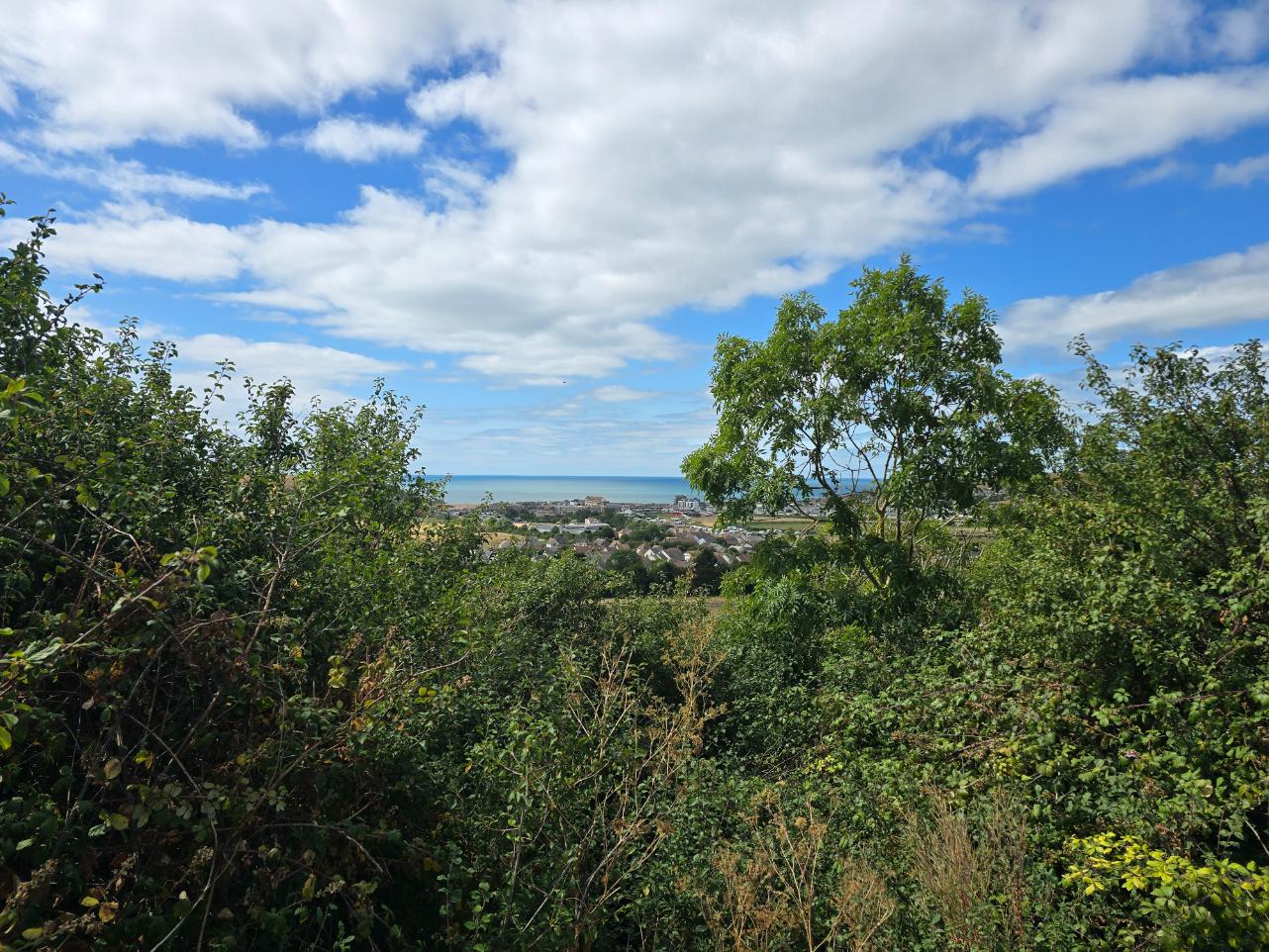
There’s a point on the climb above Bothenhampton where the path breaks through the tree line and a bench has been placed with the precision of someone who knew exactly what they were doing. It faces south and west. On a clear day — and 29 July was a clear day — you sit with Bridport spread below you, the coast from West Bay stretching east toward Chesil, the sea doing that particular trick it does in summer where it turns a shade of blue that looks manufactured.
I didn’t sit. But I stopped. For longer than a runner’s conscience usually permits.
The view had been there all along, of course. The fog just made it wait.
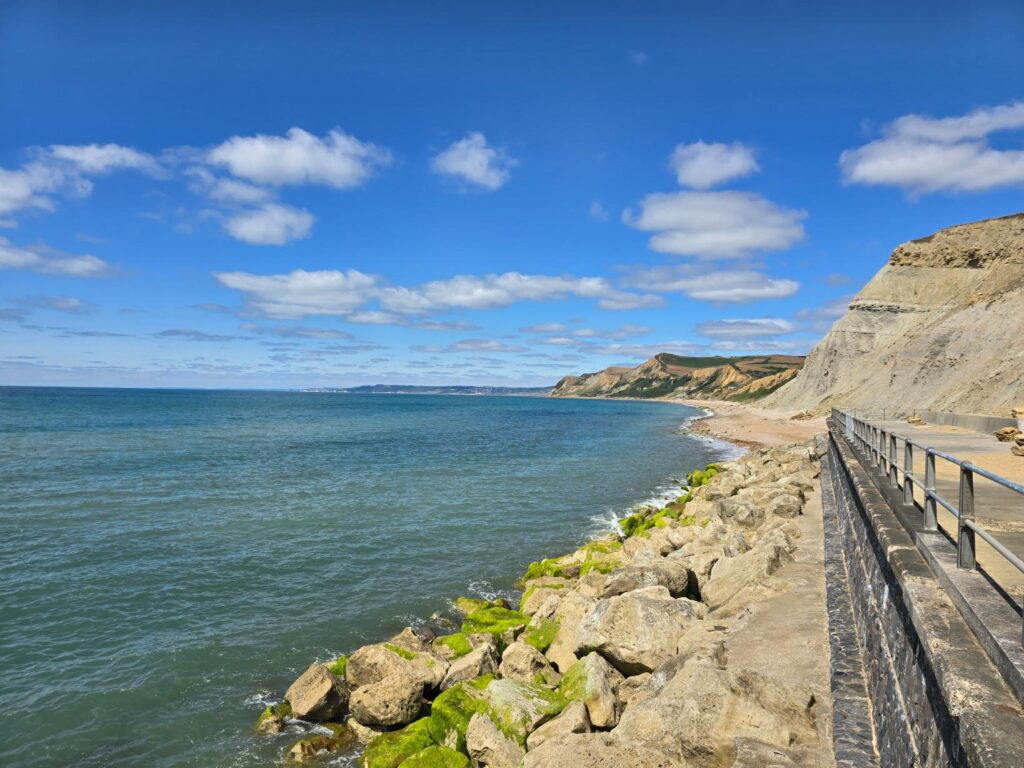
West Bay sea wall. Rocky breakwater with vivid green algae, turquoise water, East Cliff’s layered sandstone rising behind. Blue sky. An almost Mediterranean quality to the colour.
West Bay in summer
The descent from Bothenhampton brings you into West Bay from the east, arriving at the harbour just as the holiday version of the place is in full swing. In July this means families, ice cream, people who’ve driven from somewhere inland specifically for this view. You can’t blame them.
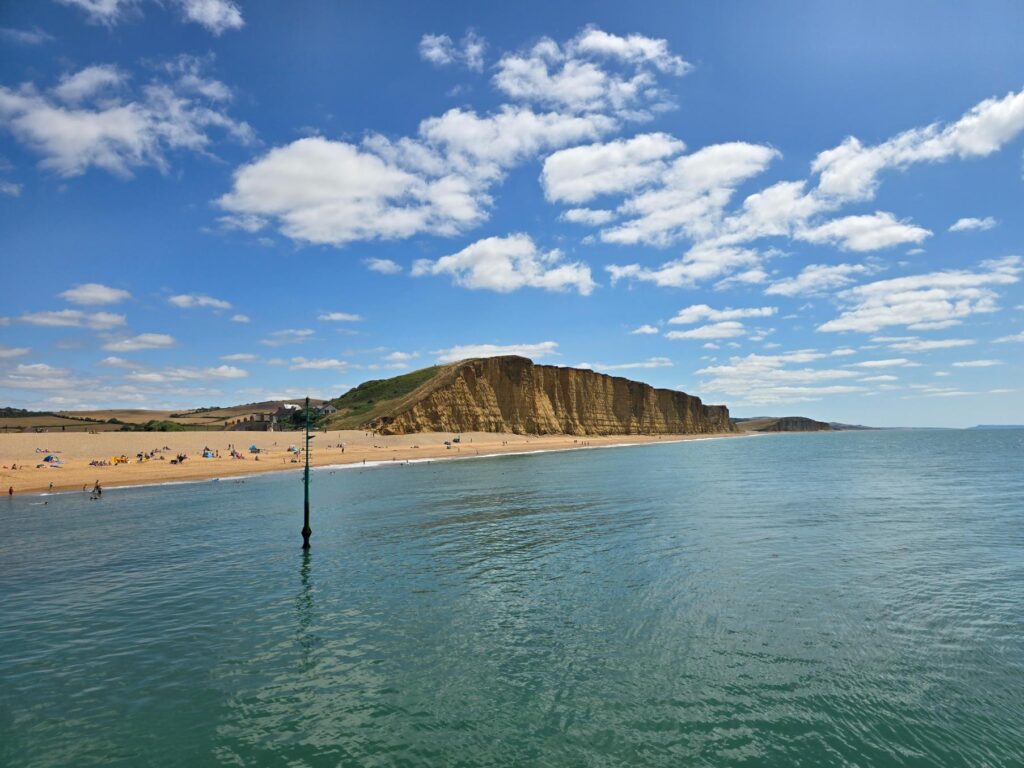
West Bay beach and East Cliff from the harbour, green navigation marker in the foreground. The beach busy with summer visitors, the cliff sheer and golden-red above them. A classic.
East Cliff is the defining feature — that vertical face of Bridport sandstone, layered and stratified like a geological diagram, rising straight from the shingle. It’s been here for one hundred and eighty million years. The summer visitors are a recent development. From the sea wall, the composition is obvious: water, beach, cliff, sky. It’s why Broadchurch filmed here, and why the car park is full by ten.
The sea wall itself is worth running. On a calm day the water on the rock-armour side is clear enough to watch through, green and shallow over pale stone. On the headland side the water is deeper, moving differently. You’re between two versions of the sea at the same time.
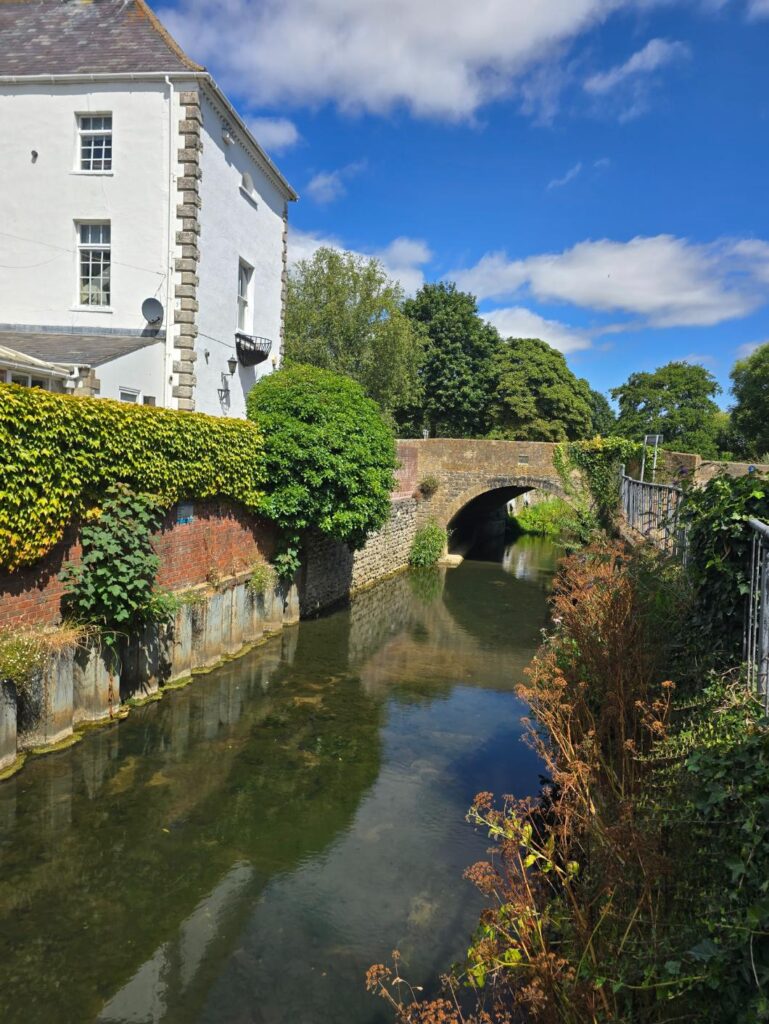
Stone arch bridge over the River Brit, Bridport town. Ivy cascades over old brick walls, the arch reflected in still water. A Georgian townhouse beside it catches the morning sun.
What the town holds
The return leg brings you back through Bridport itself — through the rope-walk alleys and the narrow cuts between old buildings that give the town its particular character. The Tanyard. Folly Mill Lane. The cobbled courtyard behind the high street where converted mill buildings still wear their industrial bones. This town made rope for the Royal Navy for centuries; the streets are wide enough to braid it in, which is why Bridport’s layout doesn’t quite make sense until someone tells you that.
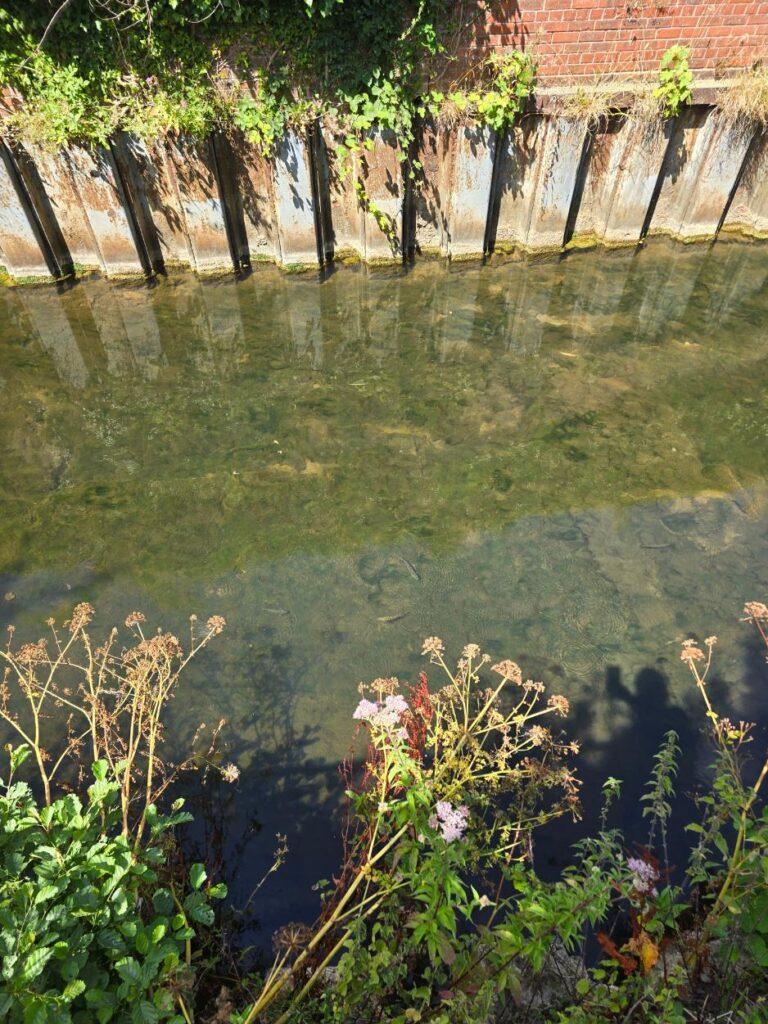
Looking down into the River Asker from the bridge. The water is exceptionally clear, the river bed visible, a fish moving just below the surface. Steel piling on the far bank reflects in the water.
At one of the river bridges — the River Asker runs through the town in a way most visitors don’t notice — the water is clear enough to see the bottom, and clear enough, on this particular morning, to watch a fish holding position in the current while the town runs its business overhead. It’s one of those details that requires you to stop and look properly. Worth the pause.
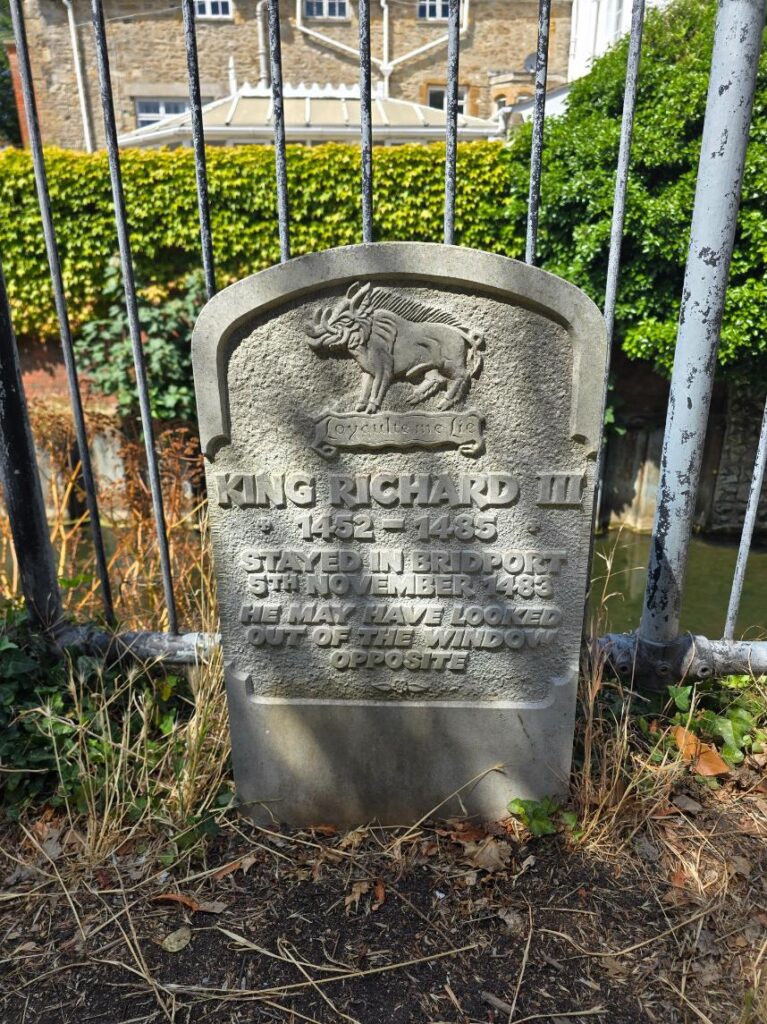
The King Richard III commemorative stone beside the river railings. Inscribed: “KING RICHARD III 1452–1485. STAYED IN BRIDPORT 5TH NOVEMBER 1483. HE MAY HAVE LOOKED OUT OF THE WINDOW OPPOSITE.” The white building opposite is just visible behind the railings.
He may have looked out of the window opposite
I nearly ran past it.
Tucked against the river railings, half-hidden by grass, there’s a commemorative stone. King Richard III, it announces, stayed in Bridport on 5th November 1483 — two years before Bosworth, two years before everything fell apart. And then, in the same font and with complete seriousness: He may have looked out of the window opposite.
This is the best piece of public history writing I have encountered in some time. It commits absolutely to what can be known — the date, the stay — and then offers, with perfect candour, the one thing it cannot confirm but cannot quite resist. He may have looked out of the window. There it is. The building opposite has no windows that could date to 1483, which makes the stone’s careful hedging even better. Someone thought very hard about this inscription and got it exactly right.
I stood there for a while. It seemed appropriate.
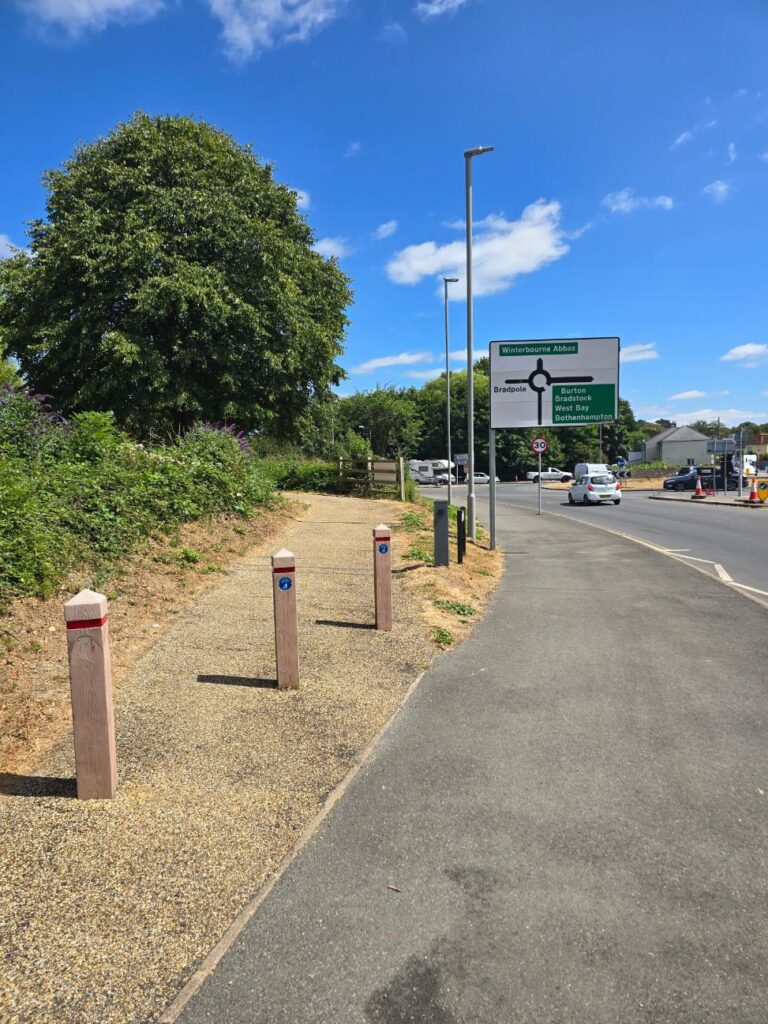
The Old Line path entry. Wooden bollards with cycling signs, the path heading south between summer hedgerows. A green roundabout sign reads: Burton Bradstock, West Bay, Bothenhampton. Bridport on a clear day.
The Old Line
The route’s defining mid-section runs along the former Bridport Railway — the branch line that connected this town to the mainline at Maiden Newton from 1857 until 1975. The track is long gone. What remains is the path: flat, direct, wide enough for two runners side by side, with the River Brit running alongside through the sculpture meadow and the town giving way to open green on both sides.
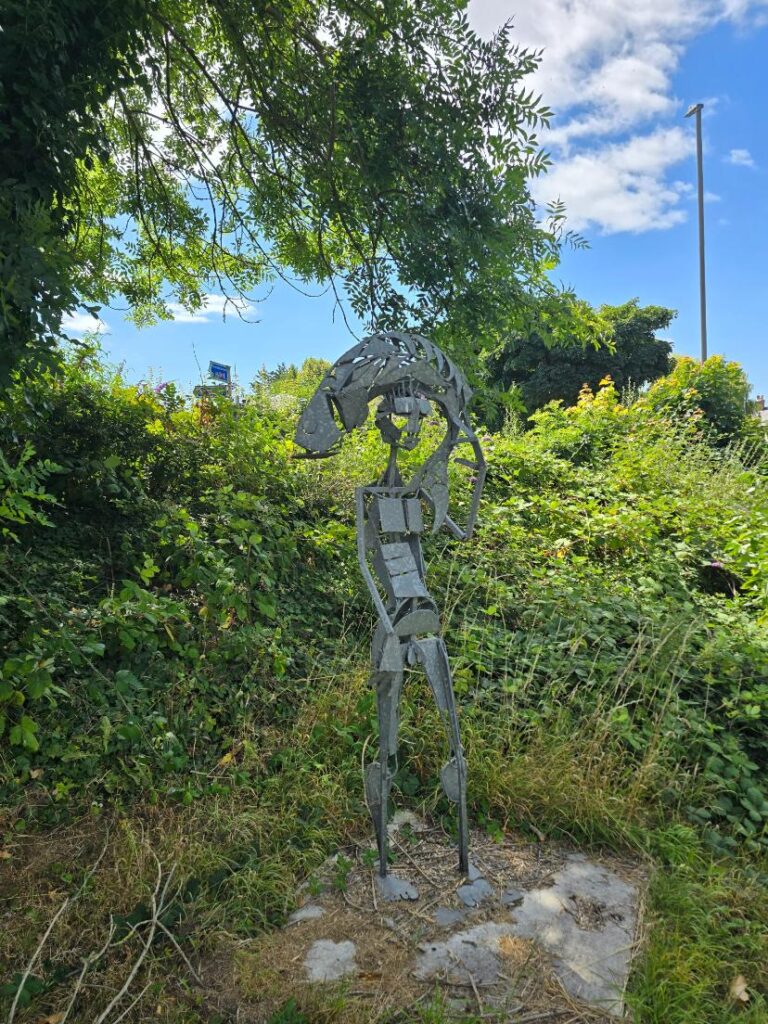
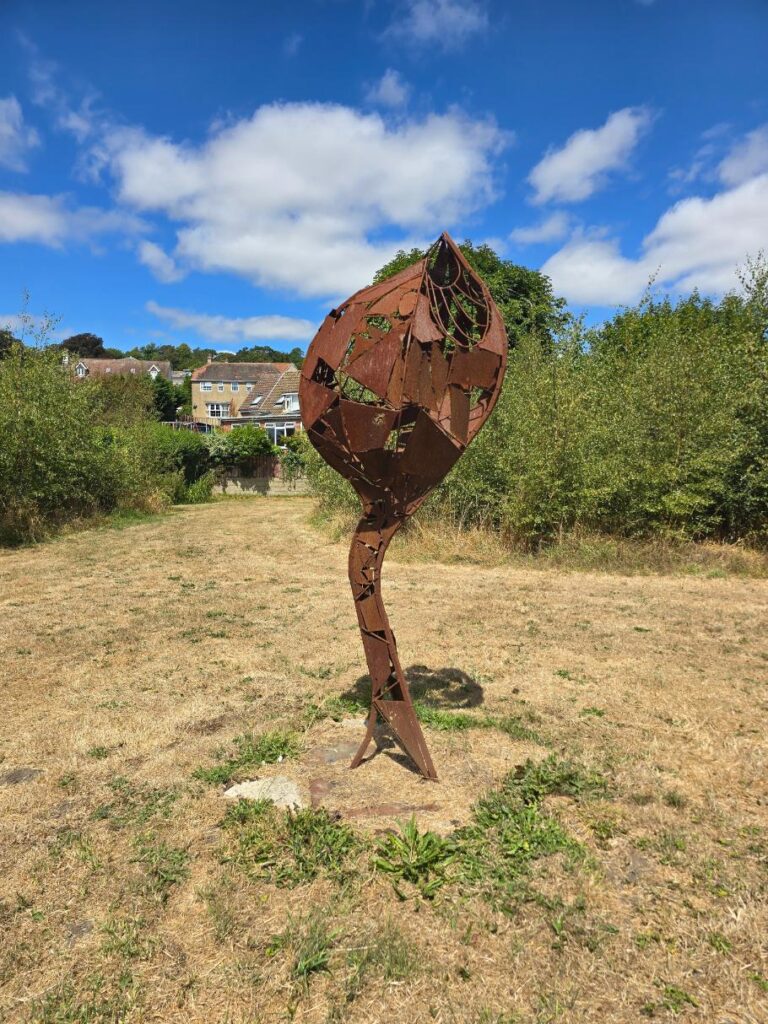
Large rust-iron sculpture in an open meadow. The piece has a bulbous, almost organic form — a poppy head or seed vessel — on a twisting stem, the rusted iron surface catching the morning light.
The meadow section beside the Old Line is home to a sequence of outdoor sculptures — bronze figures, rusted iron forms, steel wire constructions — installed along the river path. In the fog they were shapes emerging from grey. In sunshine they’re something else: substantial, considered, each one in conversation with the water and the meadow around it. We’ll come back to this section properly at some point — there’s a shorter, flatter route here that works well as a standalone, and the sculpture trail deserves more than a passing mention on a longer run.
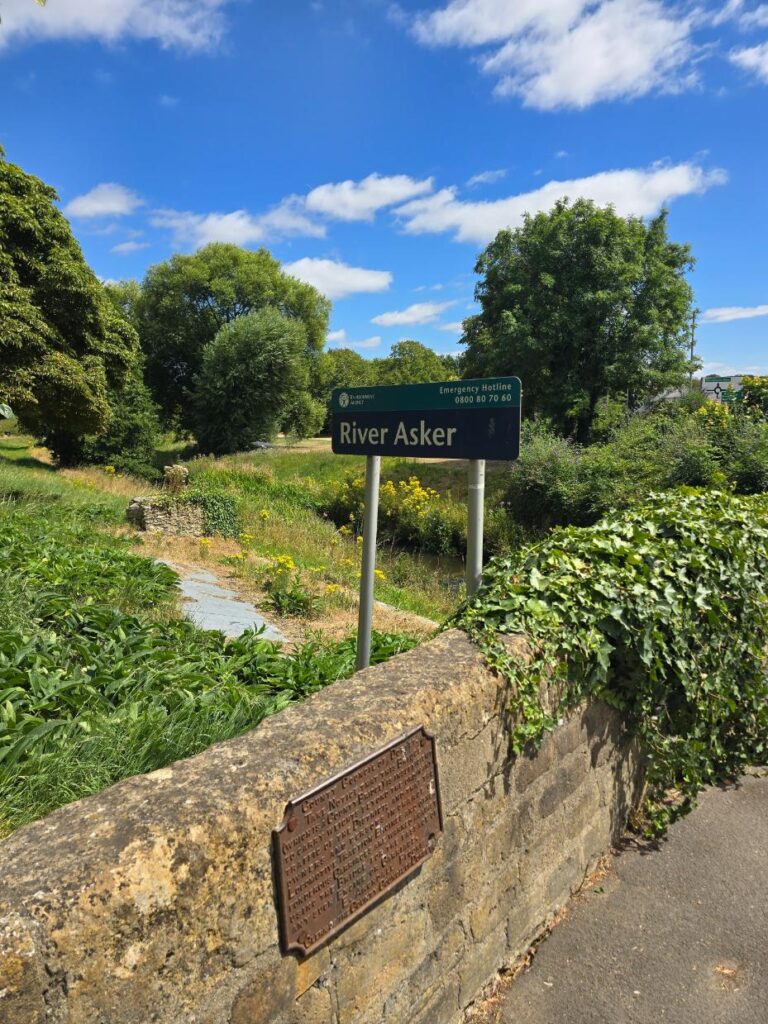
River Asker sign in front of a summer meadow, ragwort in yellow flower, the river cutting through. A bronze plaque on the stone bridge below the sign. Very English, very Dorset.
The Old Line brings you back into Bridport past the River Asker confluence — the Asker flowing in from the east, the Brit continuing south to the sea. At this point the town reassembles around you gradually: the Bridport FC ground beside the path, the sound of the A35 ahead, and then you’re back on familiar streets with 7.45 miles on the watch and the knowledge that this route is confirmed.
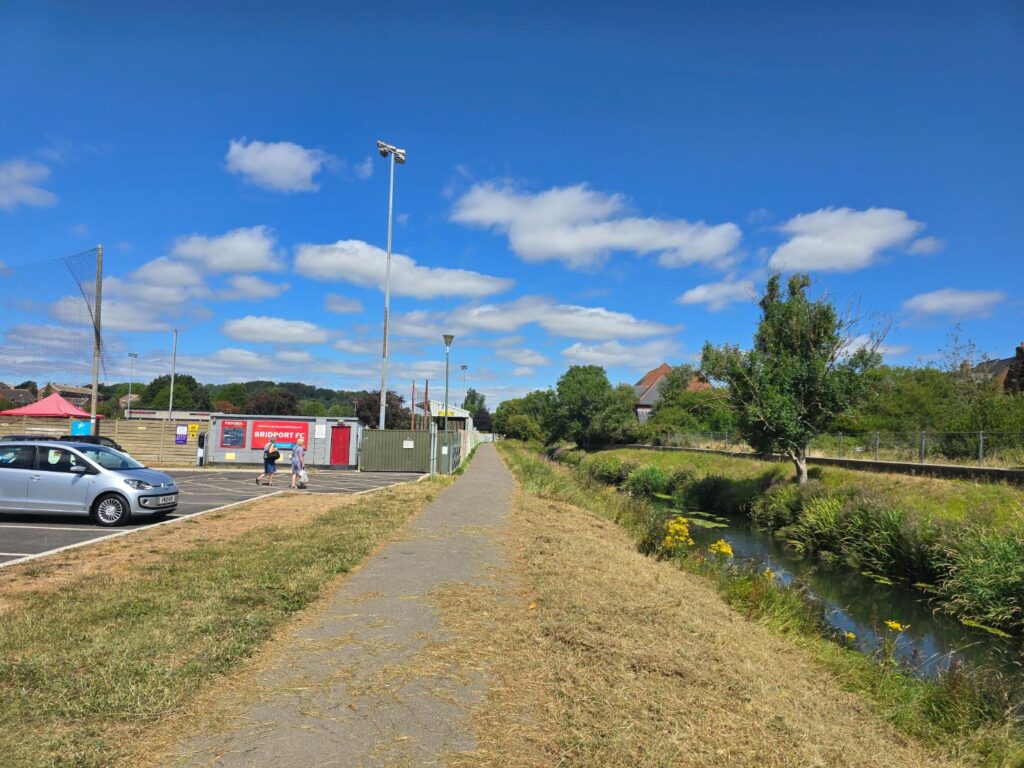
The Old Line path alongside Bridport FC, river on the right, the path running straight ahead between the ground’s perimeter and the water. Midsummer, long grass, quiet.
For the record
The fog run told us the bones of this route were good. The sunshine run confirmed it. The Bothenhampton climb has real elevation for a town-based run — 348 feet over 7.45 miles isn’t significant on paper, but the way it front-loads the effort and then rewards you with the descent into West Bay is well-designed, as if someone planned it, which no one did. The Old Line section gives a group the chance to spread out, talk, recover. The town centre passages give it character. The bench gives it a moment.
Local Legend on Final sprint, for what it’s worth. Third best time on the Bothenhampton Nature Reserve climb, which the fog run didn’t threaten.
This one is confirmed.