

Valencia wasn’t on the original itinerary. A colleague at work — his parents are from here — heard we were heading to Alicante and said, essentially: while you’re that close, you’d be mad not to. So we added a couple of days, got the train north, and within ten minutes of arriving we were standing in front of a beautiful building photographing it and sending it to him with the message: where are we? He replied immediately. Town Hall, he said. Of course it was.

The square opens up
Valencia does something that very few cities manage — it reveals itself immediately and completely without feeling like it’s showing off. You walk out of the old streets and suddenly you’re in the Plaça de l’Ajuntament, all grand facades and evening light, and the city just hands it to you. No build-up. No queue. There it was.
We stopped for a beer earlier than we normally would. The heat was serious, even for mid-April. A small dish of peanuts arrived with the drinks — still in their shells, which we didn’t immediately register — and we ate several of them whole before working out why they tasted so aggressively salty. Reader, we were a little cooked.

Plaça de la Verge — the Turia fountain, the cathedral, and approximately everyone in Valencia.

Valencia Cathedral, baroque facade. The city turns its best face to the night.
The night shift
We walked until late on the first evening. Valencia at night is a different city from Valencia in the afternoon — quieter in the streets, louder somehow in its architecture. Everything gets lit up and the effect is theatrical without being tacky. The Mercat Central in particular, all Art Nouveau ironwork and stained glass, looks at night like something a production designer would build and nobody would believe was real.
We found street art on almost every corner — some of it colossal, some of it tucked into alleys you’d only find if you were lost, which we frequently were. There was a geometric mural that ran the full length of a narrow street: black and white figures on pastel triangle panels, hundreds of them, all slightly unhinged. We stood in front of it for longer than seemed reasonable.
The Torres de Serranos — the medieval gate at the north end of the old city — stopped us completely. You walk towards it and it frames a lit church tower in the archway behind, and the whole thing feels staged. It isn’t. It’s just Valencia being Valencia.

Mercat Central. Art Nouveau. Closed for the night. Still the best-looking building on the street.

Geometric street mural, Ciutat Vella. Hundreds of figures. No explanation offered or needed.

Torres de Serranos. 14th century. The church tower through the arch is not arranged for your benefit. It’s just like that.
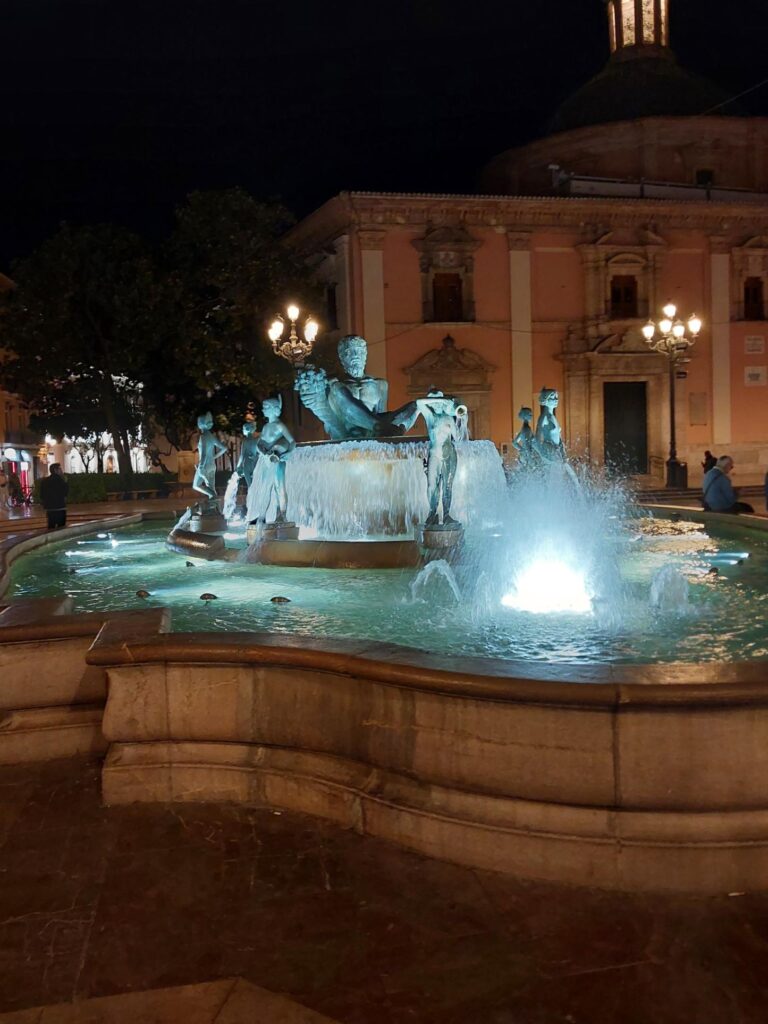
The Turia fountain, Plaça de la Verge. Late evening. The river god does not look impressed.
Star Trek
The next morning we walked to the Turia Gardens — the old riverbed, drained in the 1950s after catastrophic flooding and turned into nine kilometres of parkland running through the city. In April it was full of blossom: pink and white trees, bougainvillea draped over steel pergolas in tunnels of red that you walked through slowly because there was no reason to hurry.
At the far end of the gardens, the City of Arts and Sciences appears. There is no preparing for it. Sarah and I both stopped walking at roughly the same moment and stood there saying nothing particularly useful. The Museu de les Ciències Príncep Felip — white exoskeleton ribs, turquoise reflecting pool — looks like a creature that has climbed out of the water and is considering its options. The Palau de les Arts Reina Sofía next to it is a white wing, or a helmet, or a shell — it changes depending on where you’re standing. The Umbracle walkway has repeating blue ceramic fins that recede into the distance like something a production designer would build for a starship interior.
We walked through all of it. We went back and walked through some of it again.

The bougainvillea tunnel, Turia Gardens. April. Worth the detour on its own.

The water channel, Turia Gardens. The old riverbed, running through the city.

Sarah photographing the Umbracle fins. She had the right idea.

Museu de les Ciències Príncep Felip. Turquoise pool. White ribs. The city’s most quietly extraordinary building.

Palau de les Arts Reina Sofía. We stood here for a while. Neither of us had much to say.
Paella
You don’t come to Valencia and order something else. We sat near the seafront and the pan arrived — proper seafood paella, mussels and prawns and clams in saffron rice, a wedge of lemon on the side — and it was exactly what it was supposed to be. The kind of dish that makes you wonder why you ever eat anything else anywhere. We ate all of it.

Paella de marisco. Valencia. Non-negotiable.
The beach
The walk to Malvarrosa beach took us past more murals — including a woman the height of a house, rolling paint across a wall with a giant brush — and a vintage-style beach bar with hand-painted advertisement boards covering every surface: Anis El Mono, Orangina, Licor Dandy 1915. It looked like a film set. It was open for business.
The beach itself was enormous and almost empty. A cruise ship sat on the horizon. The Mediterranean was flat and blue and doing absolutely nothing. We walked to the waterline and stood there for a minute, which felt like the correct response.

Malvarrosa Beach. April. Cruise ship. Nobody else bothered.

The freiduria on the seafront. The signs are original. The beer is cold.
Back through the old town
The afternoon took us back through the centre — past the Torres de Quart, the other medieval gate, pocked with cannonball damage that nobody has ever bothered to repair — through back streets where the murals got stranger and more political, until we arrived back at the Mercat Central in late afternoon light. It looks completely different in the day. Still extraordinary.
Valencia does this. Every building has two versions of itself — the daytime one and the night one — and you get the feeling you’d need a week to do it properly. We had two days and covered fifteen and a half miles. It didn’t feel like enough.

Mercat Central, afternoon. The ironwork. The tile panels. Sarah, for scale.

Torres de Quart. The cannonball damage is original. It adds to the argument.
Valencia, Spain — 15.58 miles combined — 5hrs 37min — 298ft — 35,529 steps