

We were in Málaga with Kara and Tom. A proper trip — four of us, a good apartment, the kind of January that feels like an act of rebellion against the grey you’ve left behind at home. We’d arrived the day before, having tagged on a few extra days to the trip rather than go straight to Benalmádena like sensible people. The city had made an excellent first impression just by being warm and alive when everything in England was neither of those things.
I’d looked up the Paraje Natural Desembocadura del Guadalhorce before we left. A nature reserve at the mouth of the Guadalhorce river, five minutes from the seafront. Flamingos, lagoons, the whole thing. One of those places that sounds almost too good to be real — a wetland reserve wedged between a city and the sea, with mountains directly behind it. First morning. Of course I was going out.
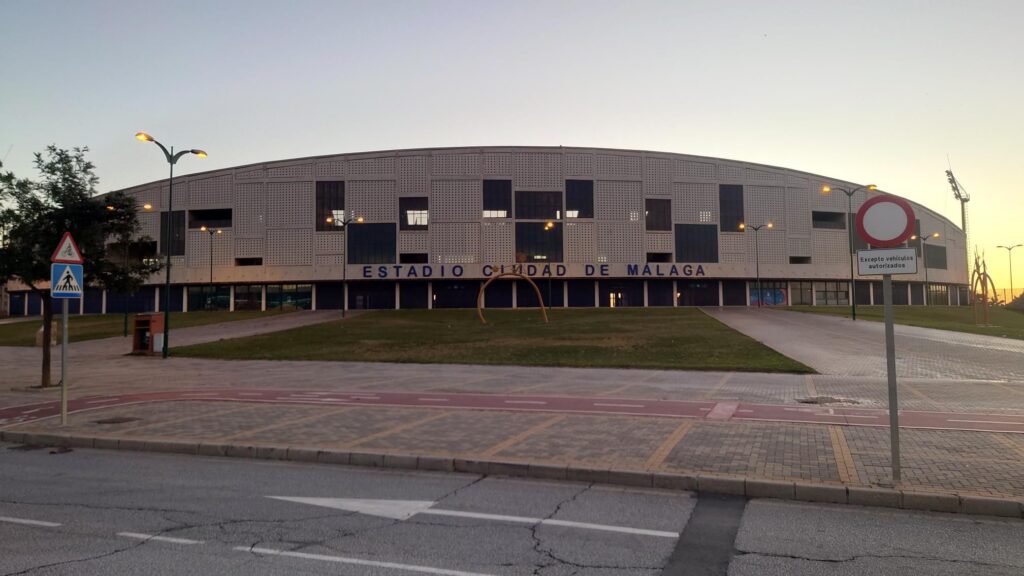
Estadio Ciudad de Málaga in the pre-dawn — perforated concrete shell lit from within, sky barely turning. The city was still asleep.
Out before the light
I left before seven. The streets around the stadium were still dark, still quiet, just the hum of early traffic and the city working itself awake. The Estadio Ciudad de Málaga sat there in the near-dark — a curved, perforated shell of pale concrete, lit from underneath, lights still on from the night before or just coming on for the morning. Either way, it looked better in that light than it probably should.
From there, west. Through the Barrio de Santa Paula — the neighbourhood sign sitting primly in a roundabout flanked by palm trees, the street lights making everything amber and blue at once. A church at a crossroads, Parroquia S. Patricio, its bell tower catching the first proper colour of the day. Nobody much around.

Santa Paula. The neighbourhood sign that gets photographed by runners at this hour.

Parroquia San Patricio. Gothic-arched doorway, rose window. Empty crossroads.
By the time I reached the Paseo Marítimo the sky had properly arrived. Palm trees, the sea, a long seafront promenade built for strolling and running and existing in good weather. Two other people ahead of me — one in a red coat — both already out, already moving. The chiringuitos were shuttered, the beach clubs still locked. The morning belonged to runners.

Paseo Marítimo. Two early runners ahead. The chiringuitos not yet open. All the light going in the right direction.
La Térmica
The chimney appears from a distance before anything else does. A tall Victorian brick stack, alone on the seafront, tapering to a point against the deep January blue. La Térmica — what remains of a nineteenth-century sugar factory, kept standing long after the industry went, now a heritage marker and arts centre with a park and workout bars around its base.
Seen from up close, it is genuinely extraordinary. The brickwork spirals faintly as it narrows; the thing feels like it’s still going up when you look at it. Seen from along the beach, it functions as a landmark that organises the whole waterfront — everything measured from that chimney. In the distance, the port cranes mirror it slightly; working towers against a heritage one.

La Térmica. The Victorian sugar factory chimney that has been here since before everything else on this stretch of seafront.

La Térmica from the promenade — chimney, palms, sea, mountains. The geography of Málaga in one frame.
The seafront continues west past the chimney, past an abstract rusted steel sculpture in a palm-tree clearing — angular body, raised arm, the kind of public art that divides opinion and that I photographed anyway — and then past a stainless steel piece mounted on a stone plinth, catching the sun coming off the water behind it.

The steel figure on the Paseo. It has been there long enough that the park has grown around it.

The stainless piece along the promenade — the sea is behind it, the mountains further still.
Into the reserve
The path into the Paraje Natural Desembocadura del Guadalhorce begins with a sign. No salirse del camino — don’t leave the path — which has been translated into English on the same sign as Don’t get out of the way. I stopped for a moment. I stayed on the path.

The reserve entrance sign. Andalucía’s finest translation work.
The reserve opened up immediately. Lagoons with russet marsh grass, waterbirds moving across the surface, the Málaga skyline visible across the water with mountains stacked behind it. The kind of place that should be an hour from anywhere and somehow isn’t — the city is right there, the airport is a kilometre away, and in between there are flamingos.

The Guadalhorce reserve looking back toward the city. Mountains, lagoon, marsh grass catching the early light.
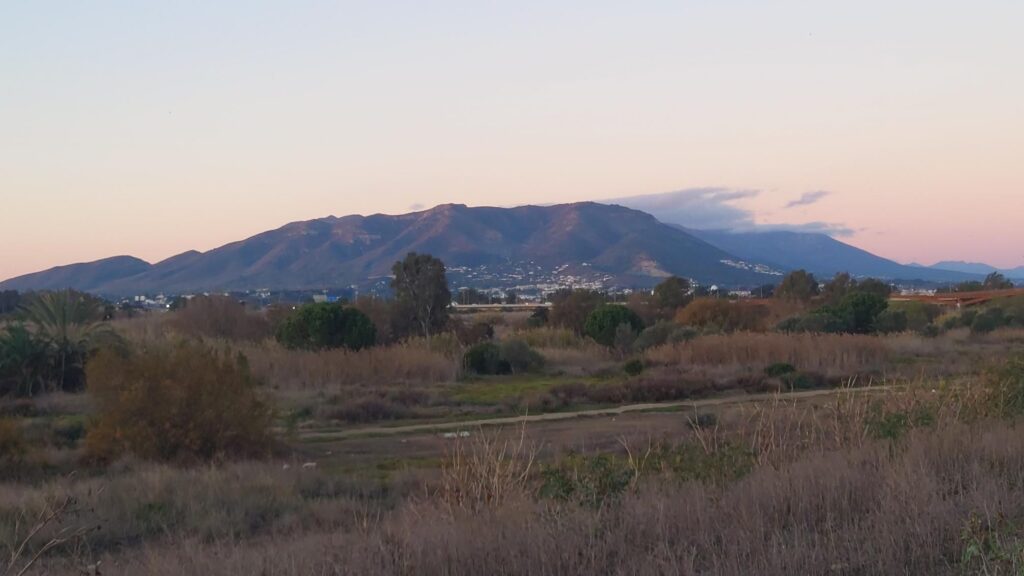
Pink sky over the wetlands. The mountains to the east of the city from somewhere inside the reserve.
I ran along the raised wooden boardwalk — the wide bridge that crosses the reserve, vanishing-point perspective, the sky still pale and cool to the west, warm and rising to the east. And then the first flamingo. A silhouette in the channel, still, bent to feed, reflected in water the colour of the horizon. Then a second. The light was doing everything it was supposed to do and the camera knew it.

The boardwalk across the reserve. It looks exactly like that when you’re running it.

A flamingo, before sunrise properly arrives. The reserve channel, the trees, the orange sky.

The flamingo. The channel. The reflection. Every element of this photograph arrived at once.
I found the bird hide — a wooden structure at the edge of the main lagoon — and looked through the slot at the water below. The sun was almost fully up by now, burning behind the treeline, the lagoon reflecting everything perfectly. Tiny birds on the island at the centre. Coots on the water. The whole reserve going about its morning.

The bird hide slot, looking out across the main lagoon as the sun rises. The reserve at its best.

Sunrise over the lagoon, through the reed beds. The sun doing the work.
Back along the sea
The Guadalhorce river marks the western boundary of the reserve. I crossed it on the graffiti-tagged road bridge — the river below, the mountain directly behind the city, a single lenticular cloud sitting on its peak like something placed there deliberately. The kind of view you don’t expect on a morning run.

The Guadalhorce river from the road bridge. Mountain, river, reflection, cloud.
Then back east along the beach. The dark volcanic sand. The port cranes on the far curve of the bay. The chimney visible all the way from out here, a fixed point on the horizon. The city waking up properly now — dog walkers, a few more runners, someone sitting on the seafront wall with coffee.

Looking back toward the city along Playa de San Andrés. The chimney, the port cranes, the mountains.
I came back in through the city streets and passed the Parque del Oeste — a park with a lake at its centre, palm trees, a small bridge. Pre-dawn dark. A sculpture of a figure with its arms raised, reflected in the water. It looked like something you’d find in a dream, and I ran through it.

The Parque del Oeste lake, just before dawn. The palms, the reflection, the figure with raised arms.
Three personal records on a first morning run in a city I’d never run before. I didn’t know the streets or the distances or where anything was — I just pointed west and found it all.
We had breakfast when I got back. Sarah and Kara and Tom hadn’t yet been outside. I told them about the flamingos. They seemed sceptical.
They were right there, I said. In the reserve. Ten minutes from here.
They looked at me with the patient tolerance of people who had not yet had enough coffee.
Run · Málaga, Spain · January 20, 2024 · 9.13 mi · 1:19:06 · 147 ft · 8:40 /mi