

We had already walked eight miles. The afternoon had taken us up through the Oltrarno, across the river, back again — every major sight, most of the minor ones, and a good portion of the hills above the city. By early evening we were back at the hotel, feet done, the rain coming down properly outside. The sensible thing would have been to stay in.
We went out.

The Uffizi corridor at night. Empty, lit, Palazzo Vecchio tower framed at the far end. Nobody told us it would look like this.
What rain does to a city
Florence in February rain is not Florence diminished. It is Florence clarified. The cobbles become mirrors. Every lamppost throws two lights — one above, one below, wavering in the wet stone. The crowds thin to almost nothing and the city, which by day belongs to everyone equally, starts to feel like it might belong to you specifically.
We walked out of the hotel and into it without a plan. That is always the right decision.

Ponte Vecchio from the embankment. Wet stone, one lamp, the bridge reflected in the Arno. Nobody else there.

The Arno looking east. Two figures on the wall. San Miniato al Monte lit purple on the hill above.
The Uffizi, empty
Walking through the Uffizi corridor at night — the long colonnade that runs between the two wings of the gallery, Palazzo Vecchio tower at the far end — is one of those experiences that arrives without warning. By day this is a queue. A very long queue, in both directions, with tour groups and selfie sticks and the particular chaos of a world-famous museum forecourt. At half past eight on a wet February evening it was empty. Two cars. The tower lit amber at the end of the perspective. The columns casting shadows on the stone.
We stood there for a while and did not say much.

The Loggia dei Lanzi. Walked in off the street at night and found classical marble inside. Nobody checking tickets.
Piazza della Signoria
The square is never fully empty — there are always a few people, always someone photographing Palazzo Vecchio — but in the rain the proportions shift. The Fountain of Neptune stands white against the dark stone wall of the palazzo, the bronze figures around him caught mid-gesture. The equestrian statues watch from their plinths. The Loggia dei Lanzi is open on three sides and free to walk into, which we did, finding classical marble under the vaulted ceiling out of the rain while the square glittered outside.

Palazzo Vecchio and Piazza della Signoria. Two figures, the tower, the Loggia. The square at its quietest.

The Fountain of Neptune. White marble, wet piazza, the palazzo wall behind.
A vaulted ceiling and a Medici coat of arms
We found a passageway — one of those covered passages that cut between buildings in the old city — and looked up. The ceiling was vaulted and painted: a cherub in a blue medallion at the centre, a Medici coat of arms below it, another smaller roundel further along. The plasterwork was cracked and spotted with age. The lights were modern. Nobody had suggested we go this way. There was no reason to be here except that it was the way we happened to go.
This is the only method that finds this kind of thing. You cannot plan for a painted ceiling in a passageway. You can only keep walking.

Vaulted passage off Piazza della Repubblica. A cherub, a Medici coat of arms, spotted plasterwork. Nobody told us to come here.
The Duomo at night
You go to the Duomo because you have to — it is the centre of gravity of the city and there is no route that doesn’t eventually bend toward it. What surprises you is the scale. In photographs the Duomo is always contained, always framed. In person, at night, in the rain, with Brunelleschi’s dome rising above the nave and Giotto’s Campanile beside it, both floodlit against the black sky, it is simply too large for a single image. You walk around it. You look up at different points. It keeps being bigger than you thought.
The marble bands — white and green and terracotta — glow under the floodlights in a way they don’t manage in daylight. The wet piazza reflects the light back upward. A winged pop-art horse on a plinth outside a nearby palazzo — Marco Lodola’s Cavallo Alato, vivid red and blue and yellow against the dark stone — makes absolutely no sense next to a thirteenth-century cathedral and is somehow exactly right.

Giotto’s Campanile. Looking straight up. The marble banding under floodlights.
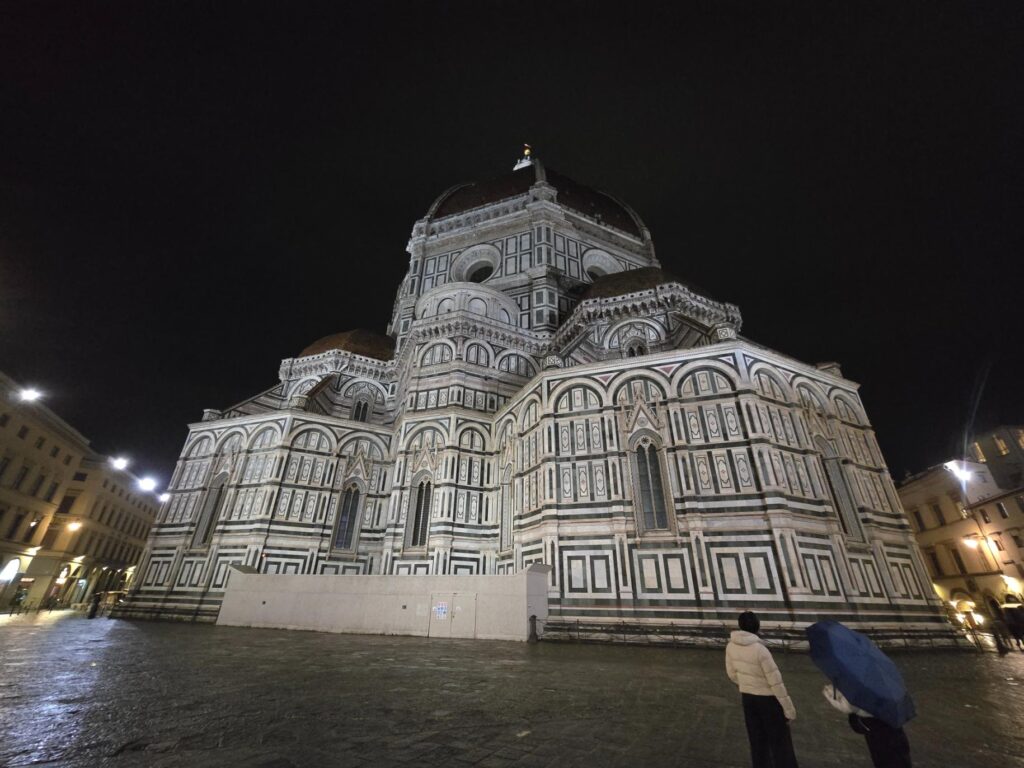
Brunelleschi’s dome from the south side. Two figures, one umbrella. The scale of it.

Marco Lodola’s Cavallo Alato, 2025. A pop-art winged horse beside a Gothic cathedral. Florence lets these things coexist.
Santa Croce
We ended up at Santa Croce — the walk took us east through the wet streets, through Piazza della Repubblica, past the zodiac signs glowing in the pavement of a side street (twelve illuminated medallions set into the stone, part of an old gnomon sundial, still marking the meridian after centuries), and out into the wide square. The facade was floodlit: white and green marble, the Star of David in blue and gold above the rose window, Dante’s statue in white marble at the left side of the steps, two stone lions at his feet.
The frescoed palazzo opposite — painted figures across every floor, visible from across the empty square — reflected in the wet paving stones below it.

Santa Croce facade. Floodlit white and green, empty piazza, the rain still coming down.

Dante Alighieri outside Santa Croce. Two lions, the inscription, the church facade. February, past nine o’clock.

The frescoed palazzo, Piazza Santa Croce. Painted across every floor. Reflected in the wet stone below.
We walked back to the hotel through the shopping streets — Via de’ Calzaiuoli wet and gold under its lamps, a few people still moving through — and the Piazza della Santissima Annunziata, where an equestrian statue of Ferdinando I stood in the rain and a baroque fountain threw bronze sea creatures toward the dark sky, pink ribbons on the railings around the basin for reasons we didn’t investigate.
We had now walked nearly thirteen miles in a single day. We had done this after deciding, at some point in the late afternoon, that we needed to go back out.
Florence in the rain at night is not a consolation prize. It is the version of the city that most people don’t bother to find. We are glad we bothered.
Florence, Tuscany — 4.27 miles — 1hr 40m — 98ft — 9,884 steps