

Siena does not ease you in. The bus from Florence drops you at the foot of the city and from there, it is up. Properly up. There are escalators — a concession to geography that feels slightly surreal in a medieval city — and even with them, you arrive at street level breathing a little harder than you expected, already slightly on the back foot. Which, it turns out, is exactly the right way to arrive.
We had walked some of Siena the previous evening. Just a recce, just enough to know where things were. Now, with a full day in front of us, we went looking for the cathedral.

Duomo west façade, the whole extraordinary thing
Inside
The Duomo di Siena charges an entry fee and it is absolutely worth it. We knew this going in. What we did not quite know was what “absolutely worth it” was going to mean in practice.
You walk through the doors and the interior stops you. The striped columns — black and white marble, floor to ceiling — run the full length of the nave in both directions and the effect is almost disorienting, like standing inside something that has its own rules of space.
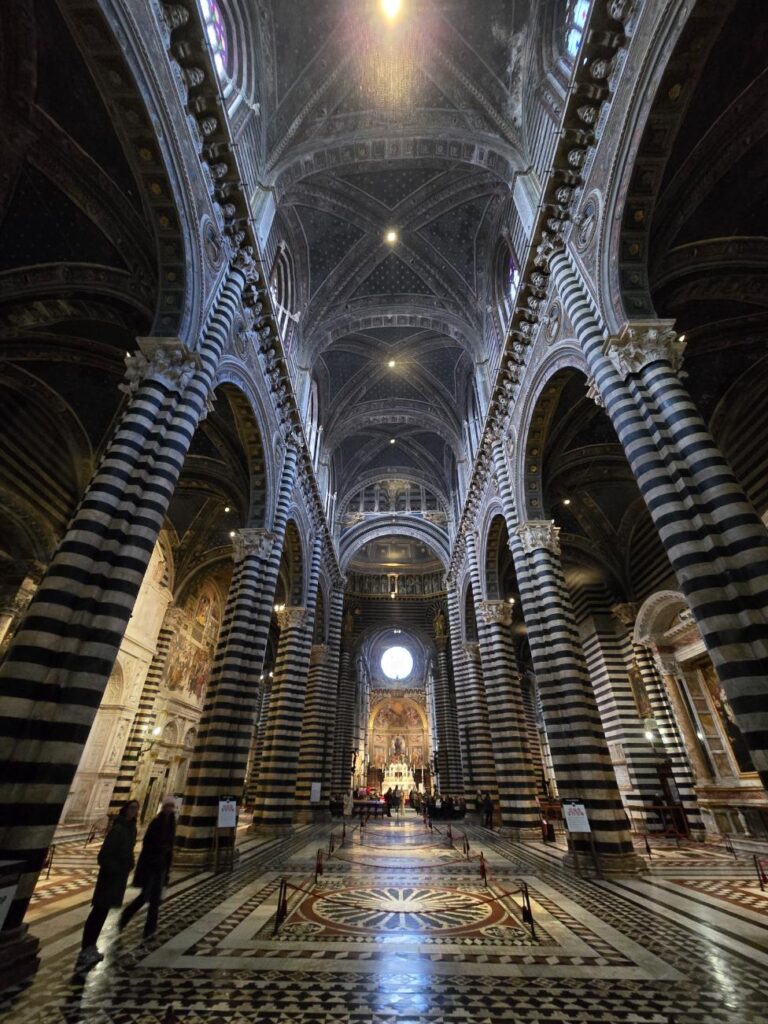
Full nave, from the altar end looking back, the rose window in the distance
We stood there for a while. You need to. There is too much happening at once to process immediately — the columns, the decorated ceiling with its gilded stars, the pulpit in the middle of it all, the floor beneath your feet that turns out to be something else entirely.

Nicola Pisano’s pulpit, lions at the base, carved panels crowded with figures
The floor
The marble floor is something we had not anticipated. Fifty-six inlaid panels — narrative scenes, heraldic designs, biblical stories — running the full length of the cathedral, most of them roped off. Some are in black and white, incised into the stone. Others are in full colour, inlaid marble, battle scenes with horses and soldiers covering an area the size of a small room.

The marble floor battle scene, red rope in foreground, horses and figures across the whole panel
You find yourself looking down as much as up, which is not something that happens often in a cathedral.
The chapel
Off to one side is a chapel with a dome that opens to the sky through an oculus. We tilted our heads back and stood there looking up through rings of carved stone and painted surfaces receding towards a circle of pale February light.

Chapel dome looking straight up, the oculus, gilded hexagons and arches
The library
The Piccolomini Library is a separate room inside the cathedral, easy to miss if you are moving quickly. The frescoes cover every surface — floor to ceiling, wall to wall, ten enormous narrative panels showing scenes from the life of Pope Pius II, painted in colours that have stayed vivid for five centuries. The ceiling is gilded and painted with a pattern so intricate it takes a moment to understand what you are looking at.

The library full room, ceiling and frescoed walls, the Three Graces statue below
We stayed longer than we planned.
A quiet moment
Before we left the cathedral, Sarah lit a candle. She does this in churches when it feels right, and in Siena it felt right. There is nothing performative about it. She just does it and stands there for a moment, and you stand alongside her, and the cathedral does what old buildings do — it holds a silence that isn’t silence.

Sarah at the candle stand, the marble columns behind her
Out into the city
Outside again, we headed downhill — which in Siena means committing to a direction and hoping the street doesn’t end in steps. Most of them do. The city is built on three ridges meeting at the Campo and every route between them involves either climbing or descending something medieval.

Sarah walking a wet, empty Siena street, warm terracotta buildings receding ahead
The streets in this part of the city are almost entirely residential. A few bars, a pharmacy, a shop or two with their shutters up in the grey February morning. We passed the Casa di Santa Caterina — the birthplace of St Catherine of Siena, now a sanctuary — tucked into a narrow alley with a wooden door and an inscription above the lintel.

Sarah approaching the Casa di Santa Caterina door, tight alley, arched loggia above
Fontebranda
We found the Fontebranda by following the street downhill until it ended in a small piazza with three Gothic arches cut into a battlemented wall. It is one of the oldest fountains in Europe — medieval, functional for centuries, now just standing there at the bottom of a hill being extraordinary.

Fontebranda exterior, three Gothic arches, green grass, battlemented top
We looked through the arches into the chamber inside. The water is the colour of a swimming pool — an impossible turquoise-green, completely clear, with a few koi moving slowly in the stillness. Stone steps lead down to it. The vaulted ceiling recedes into the dark.
Nobody told us to come here. The guidebooks mention it briefly. We found it because we walked downhill.

Inside Fontebranda, the vaulted arches receding, turquoise water, stillness
This is exactly why we do it like this.
San Domenico
The Basilica di San Domenico is the other large church in Siena — the counterweight to the Duomo, built by the Dominicans on a hill opposite, severe and enormous. Where the Duomo is decorated to the point of overwhelming, San Domenico is almost aggressively plain: a vast terracotta floor, whitewashed walls hung with Palio flags, a timber ceiling the length of a hangar.

San Domenico full nave from the back, Palio flags, the altar and stained glass in the distance
The Chapel of St Catherine holds the saint’s head, preserved as a relic behind a golden reliquary in an ornate side chapel. Both of us stood there for a moment not quite knowing how to feel about that. It is, by any measure, an unusual thing to encounter on a Tuesday afternoon in February.

Chapel of St Catherine, golden reliquary, candles, Palio flags flanking
The Fortezza
The Fortezza Medicea sits at the top of the city — a massive sixteenth-century brick fortress built by Cosimo I de’ Medici after Florence absorbed Siena. It has been turned into a public park. The walls are open to walk, the interior is lawn and gardens, and there is a small amphitheatre in the centre that sits empty and moss-covered in winter.

The amphitheatre inside the Fortezza, curved brick seating, February empty
We walked the full circuit of the ramparts. The views from up here are worth the climb even without the fortress — Siena spread out below you on three sides, the Duomo’s campanile rising from the middle of it, the Tuscan hills running out to the horizon in every direction.

The Duomo and city from the walls, cathedral and campanile filling the frame above the rooftops
There were runners up here, looping the walls at pace. A few dog walkers. A couple sitting on a bench looking out at the same view we were looking at. This is where the city comes to breathe.

Full Siena panorama from the walls, San Domenico left, Duomo centre, the whole skyline
The Campo
We came down from the Fortezza into the Campo in the mid-afternoon, found a bar on the edge of the piazza, and sat down for what we thought would be one drink. The bar kept bringing salty snacks with every round — prosciutto, olives, something in breadcrumbs — unprompted, in quantities that made lunch entirely unnecessary. By the third or fourth round we had lost interest in finding a restaurant.

James and Sarah in the Campo, Torre del Mangia behind them
We talked about the Palio. We had looked it up the previous evening — watched footage of the race, the horses going around the Campo at speed, the crowds packed into the centre, the flags and the ceremony and the noise of it. We said we would come back for it one day. It seemed like exactly the kind of thing that demands to be seen in person.
Sarah thinks it would make a good tour. She is probably right.

The Campo, Torre del Mangia and Palazzo Pubblico, wet herringbone bricks
We stayed in a B&B just off the Campo — one of the best we have ever stayed in, by some distance. The kind of place that makes you want to mention it by name but you haven’t asked permission yet, so for now it sits here as a placeholder: five stars, no hesitation, would return without thinking about it.
Siena is a city for coming back to. We knew that before the afternoon was over.
Siena, Tuscany — 3.01 miles — 1hr 10m — 163ft — 7,190 steps