
Viareggio wasn’t the plan. We landed in Verona, caught the train to Florence, checked in, showered the travel off, and within an hour we were back on a platform heading for the Tuscan coast. It was the first night of the trip. We’d been told there was a carnival on.
We had no idea what that meant.

The lungomare at night — the boulevard closed, the whole city given over to something else entirely.
What Viareggio does to a February evening
The Carnevale di Viareggio is one of the oldest in Italy — a tradition that stretches back to 1873, and one that nobody in our social circle had ever mentioned. Not once. We arrived to find the main boulevard along the seafront completely closed to traffic, the whole width of the road filled with people, and — rising above them — a series of moving sculptures so large, so lit, so intricate in their craftsmanship, that the first thing we said to each other was something that doesn’t translate well to print.
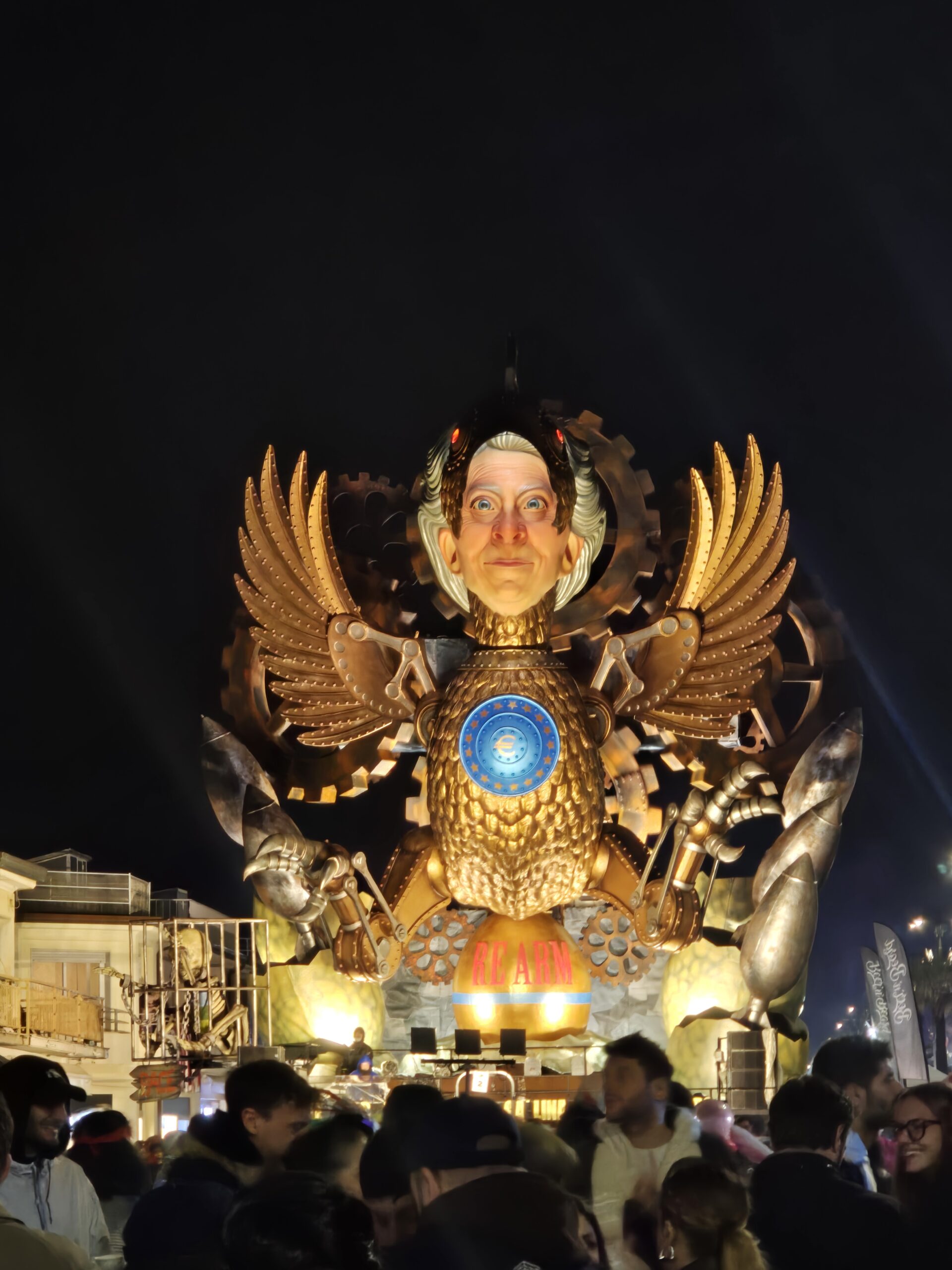
The floats are built in a tradition called carri di prima categoria — first-category wagons. They are not the decorated flat-beds you’ve seen at local carnivals. Some of these things are four storeys tall. They move. They rotate. They have articulated limbs, illuminated faces, full mechanical systems, and dozens of costumed performers aboard. Each one takes a team of builders months to construct, and they are gone by the end of the season. Built to be temporary. Built anyway.

The Viareggio clock tower — the lungomare’s axis point, its face glowing above the crowd.

A mechanical giant — wings spread, gears turning, Europe circled on its chest. Built by hand, lit from within, gone by March.
The floats
Each float is a statement. Not subtle, not deferential, not decorating around the edges of something. The Viareggio tradition has always been political satire, and this edition arrived in a particular February. One float staged what appeared to be the world’s powerful men arranged around a roulette table, the whole thing labelled Gran Casino in gold letters — the punchline writing itself. Another carried towering samurai warriors flanking a dragon in blazing reds and pinks, the kind of scale that makes you recalibrate what you thought a float could be. A third floated a full Amsterdam-style canal house — four storeys of hand-textured facade — as if someone had simply decided to build a building and put it on wheels.
There was a Wonderland-adjacent nightmare in neon blues and purples, its figures ten feet tall and grinning. There was a Red Riding Hood float with a wolf the size of a semi-detached. There was a Picasso-influenced explosion of bold flat colour with a giant cubist figure seated at its peak, holding a painter’s palette, looking entirely at ease about the whole situation.
Between the floats, walking groups in matching costumes moved through the crowd — fifty pirates, in formation, in the rain, waving at anyone who caught their eye.

The samurai and the dragon. Reds and pinks against the Viareggio sky.

The crowd between floats — umbrellas, costumes, the whole street reclassified.
It rained
It lashed, actually. We were soaked before the second float came into view. Nobody left. The umbrellas came up — hundreds of them, every colour — and the crowd moved and adjusted and carried on. There was something in the Italian approach to this that was worth noticing: the rain was not an inconvenience that required managing, it was just part of the evening. Everyone was in the same situation. Everyone was fine. The floats were still moving. The music was still playing.
We were standing in a closed street in a Tuscan seaside town in February in the rain, surrounded almost entirely by Italians, watching something that most of the English-speaking world appears to have never heard of.
That felt like the right way to be there.

The wet lungomare looking towards the procession — the colours of the floats reflected in the road.
The flatbread
At some point in the middle of it all we noticed that nearly everyone around us was eating something from a paper bag. We tracked it to a van operating out of a side square — a torta di ceci, as it turned out, a Ligurian flatbread made from chickpea flour, baked and folded and handed over hot. We joined the queue, collected two, and stood eating them in the rain among the golden costumes and the moving giants.
It was, without qualification, the right thing to be eating at that exact moment in that exact place.

The side square — food vans, covered tables, a break from the procession’s roar.
What this was
We’ve been moving through European cities for four years now, arriving by train with no agenda beyond the walk, letting the place show us what it is. Most cities reveal themselves gradually. Viareggio did it in about forty minutes.
It is a resort town that knows what it’s doing. The art nouveau architecture along the lungomare has a faded grandeur that suits February. The streets are wide and unhurried in the off-season. And in the second week of February every year, it transforms into something that requires a new set of adjectives and a much bigger camera sensor.
We paid for the standing tickets — the basic entry, no grandstand. We got the full thing anyway. The route through the closed streets meant the floats came to you, moved past you, and were replaced by the next one while you were still trying to process the last.
It’s the best carnival either of us has ever seen. That felt worth saying clearly.

The political float — chains, figures, text. Viareggio has never been shy about having an opinion.

Gran Casino. The roulette table. The cast assembled. The punchline obvious from fifty metres.
We got the late train back to Florence. It was past midnight by the time we arrived, past one by the time we were in bed. The Tuscany trip had barely started.
We talked about the amazing spectacle and the flatbread the whole way home.
Viareggio, Tuscany – 2.74 miles – 1hr 03m – 0ft elevation – 6,050 steps