

Vilnius arrived grey. Not the dramatic grey of a storm coming in but the settled, committed grey of a northern European October that has made its decision and is not open to negotiation. We wrapped up and went out anyway — we always do — and the city turned out to be nothing like we’d expected, in almost every direction.
We were staying just across the river from the Old Town. The hotel was good, the armchair in the bar better, and the walk from the front door into the city took about five minutes if you moved at anything resembling pace. We didn’t always manage that. This was a holiday in the more genuine sense — we stopped more than usual, doubled back, sat down in places that deserved it. The city rewarded that approach.

The city panorama from Gediminas Hill. The Neris river, old town rooftops, and the new Vilnius skyline in the same frame.
First impressions
The walk from the station to the hotel on the first afternoon was 2.78 miles of slow first-look. Vilnius is cleaner and more orderly than you’d expect from a city this old and this layered — everything taken care of and tidy, at least in the centre. The streets are wide in places, cobbled in others, and the architecture runs the full range from fourteenth-century brick to Soviet-era concrete to glass towers rising on the far bank of the Neris. It doesn’t try to resolve the contradiction. It just gets on with being all of those things at once.

Sarah, walking toward the Gate of Dawn. The street stretches behind her. Grey sky, everything ahead of us.
The people were noticeably warm. Not in a performed, tourist-board way — genuinely. Several conversations unprompted. A few that went longer than we’d expected. The fact that we were English seemed to generate something close to affection.
The climb
On the second day, we climbed. The Three Crosses monument sits on a hill above the city — a steep, lung-taxing ascent through autumn forest with signposts pointing in two directions as if the hill itself can’t quite decide what it is. The climb is real. By the time we got to the top we’d earned it.

The trail sign in the forest. Two directions, yellow birch behind everything, leaves covering the path.

Three Crosses. The full monument from the front. Green mound, grey sky, three white forms rising.
The hill had other surprises. Somewhere among the trees, in among the fallen leaves, a collection of dark figures — devils, demons, mythological creatures — stood arranged across a slope as if they’d just arrived and were waiting for something. No explanation at the trailhead. No interpretation board. Just the figures and the golden forest and the slightly unsettling feeling that you’d walked into something.

Devil sculptures in the autumn forest on the hill above the city. Vilnius just does this.

Sarah on the boardwalk down from the Three Crosses. Yellow all the way to the bottom.
Gediminas Tower
The Upper Castle and Gediminas Tower sit on the adjacent hill. The cobbled approach is long and polished and the tower itself — red brick, round, fourteenth century — has the particular quality of things that have simply outlasted everything that tried to stop them.

Gediminas Tower. Cobbled square, the tower beyond, people making their way up.
From the top of Gediminas Hill, the grass on the slope below had been mown into the shape of two clasped hands — an artwork you couldn’t see from the base and could only fully read from above or from the opposite hill.

Gediminas Hill from the front. The clasped hands, cut into the grass itself. The tower above.
The view from the top in the other direction — old town rooftops, the river bending, the modern city rising behind — was the one that made us stay longer than we’d planned.
The Cathedral Square
Cathedral Square is the civic heart of Vilnius — the bell tower to the left, the white neoclassical cathedral with its columns ahead, the equestrian statue of Grand Duke Gediminas in the centre, and a constant quiet flow of people crossing the cobbles in every direction. We passed through it several times. It’s the kind of square that functions.

Cathedral Square at dusk. Bell tower left, dome centre, Sarah catching the frame on the right.

The Cathedral. Columns, dusk light from inside touching the steps. Empty enough to see it properly.
The evening
Vilnius at night is a different city. The medieval restaurant on the Old Town street, which had looked interesting in the afternoon, was lit with fairy lights at dusk and considerably more persuasive.

Medininkai restaurant at dusk, fairy lights across the brick arch. One of the Old Town’s best-looking frontages.
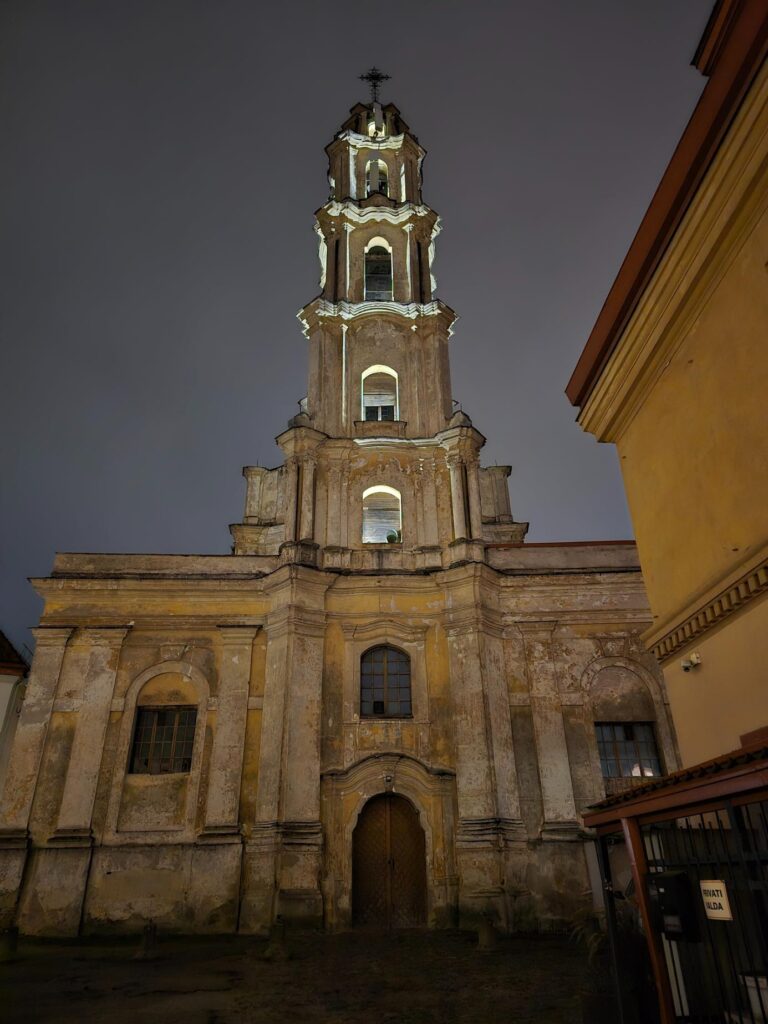
St Anne’s Church at night. Gothic brick, upward-pointing spires, gold lighting. One of the finest church facades in the Baltics.

An Orthodox church at night through an iron gate arch. Warm glow from inside, dark trees either side.

The cobbled alley at night. Low angle, lamplight receding, old walls either side. Nobody about.
We found the bar the Strava activity was named for. Devineryos. Red walls, chandelier, Svyturys on the pump. We had a pint and stayed longer than we meant to.

Devineryos bar interior. Red walls, chandelier, the Svyturys sign. Warm and slightly chaotic.

Sarah. Hotel armchair. Beer. Grey fleece. The correct way to end a day of walking.
The Jewish Quarter and the walls
Žydų gatvė — Jewish Street — runs through what was once the heart of Vilnius’s Jewish community. The city carries this history quietly but deliberately. A stencil mural near the street’s end: a bearded man in a long coat, pulling a handcart, painted in black and grey on a yellow wall. The image says something about memory without announcing itself.

Jewish quarter stencil. The man with the cart. Yellow wall, grey paint. One of the quietest and most affecting images in Vilnius.

Gates of Dawn — the surviving gate of the old city wall, with the chapel above it. Two people walking through beneath.
Uzupis
We found Uzupis by following a street that looked less like a main road and more like somewhere people actually lived. Uzupis is a district that declared independence from Lithuania in 1997 — the first of April, which tells you something about its disposition. It has its own constitution, its own president, its own ambassador to various countries that have decided to play along. No chain shops. No tourist infrastructure to speak of. Cobbled alleys, artisan studios, murals on every available surface, and a particular quality of light that has something to do with the river running through it.

Uzupis. The corner figure — a stencilled man in a top hat on a cobbled street, surrounded by art, stickers, and small notices.

Baltic Shamans café, Uzupis. The fox mural is the building. The motorbike is not complaining.

Sarah walking the river path in Uzupis. Yellow all the way down to the water. October at its most persuasive.
We walked back to the hotel in the early evening and tried to describe Uzupis to each other and couldn’t quite. That’s usually a good sign.
The last morning
The final walk — 2.59 miles back through the Old Town to the station, Kaunas next — had the particular quality of lasts. We passed things we’d already seen and looked at them differently. The city was still grey. It was still, in its way, beautiful.
We got the train south.
Vilnius, Lithuania – 18.08 miles combined – 5hr 50m – 382ft – 30,134 steps
