
“It’s forty minutes on the AVE. You’d be mad not to.” — said by nobody, but implied by the timetable
We were staying in Girona. Barcelona was forty minutes away on the high-speed train. The only reasonable thing to do was to spend a full day walking it until our legs gave up.
We took the AVE from Girona, arrived at Sants before the city had properly heated up, and stepped out into what would become one of the hottest July days we have walked through anywhere. By midday the thermometer was somewhere north of 35 degrees. The tiles were radiating heat back at you from below. The buildings were doing it from the side. Barcelona in July is a wall of heat and noise and colour, and we walked straight into it.
— PART ONE: MONTJUÏC — 7.39 miles · 2:52:43 · 420 ft elevation · 15,134 steps
The route went south and west first — up through Sants-Montjuïc, past the twin Venetian towers at Plaça d’Espanya standing guard over the approach, and up toward the hill.

The Venetian towers at Plaça d’Espanya — the gateway to Montjuïc.
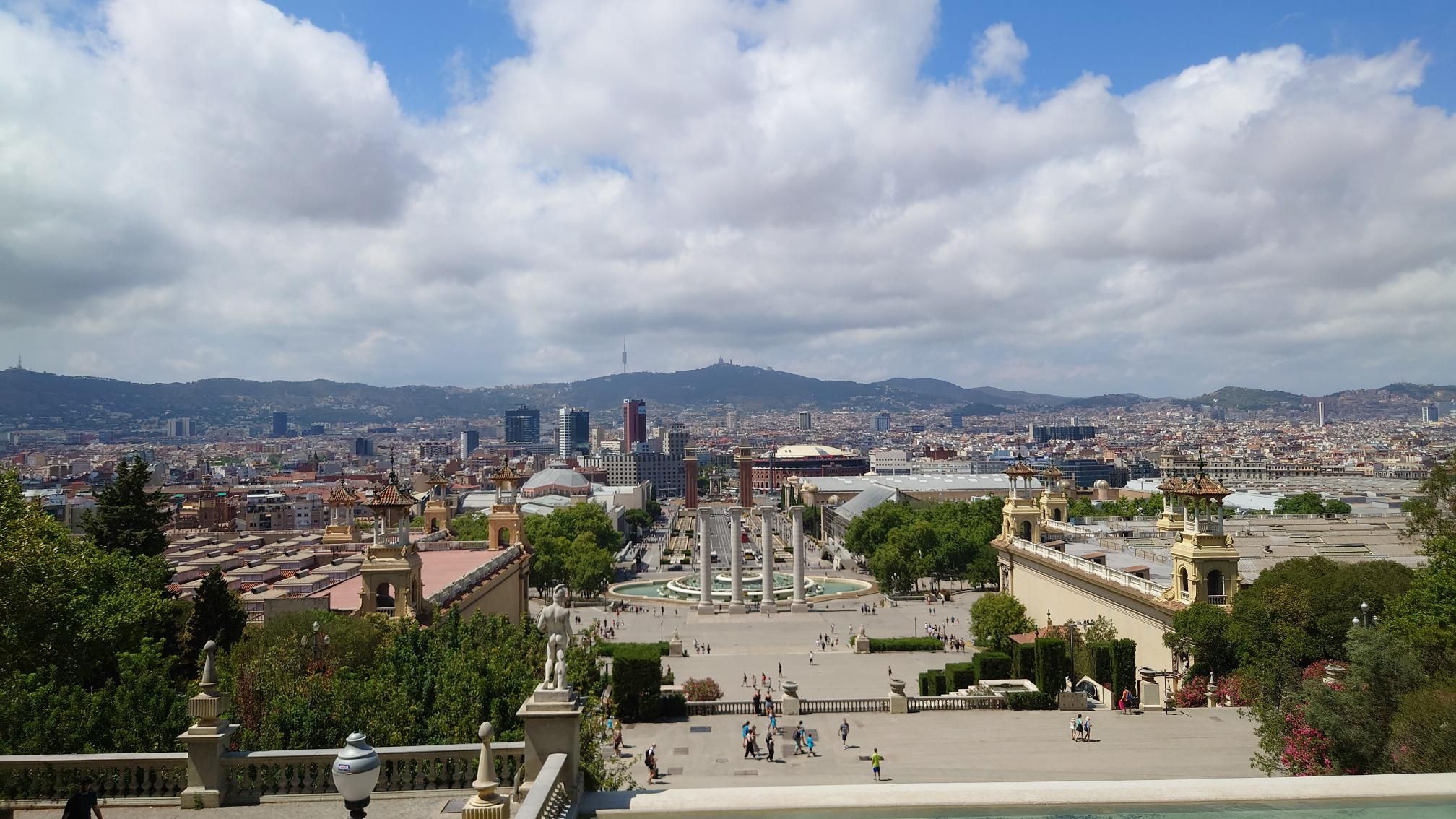
Barcelona from above is a different city. The Plaça de les Cascades opens out behind the fountains, and beyond it the whole grid unfolds toward the sea. You can see the hills on the far side. You can see Sagrada Família — still rising, still unfinished, a crane visible from five miles — on the right-hand horizon. On a clear July morning, with the mountains behind and the sea somewhere ahead, this is a view that earns the climb.

The city from Montjuïc — Sagrada Família just visible on the right horizon.
The Palau Nacional sits at the top of it all like something Rome mislaid. You walk up the ceremonial steps — wide, white, unhurried — and it rises in front of you: four towers, a dome, sandy stone against deep blue sky. Up close, in that heat, it was enormous.

Palau Nacional, Montjuïc.

Above the city. The Palau Nacional behind, the whole of Barcelona ahead.
The route across Montjuïc took us past the Teatre Grec and into the quieter parts of the hill — the gardens, the outdoor theatre circuit, the places where the tourists thin out and it’s just the heat and the trees. The Teatre Lliure sits in a beautiful ochre-and-terracotta building that looks like it could be a church, or a palace, or anything except a theatre. The Estadi Olímpic looms nearby, still carrying its 1992 energy, its classical façade incongruous against the scaffolding of modern concert staging.

Teatre Lliure, Montjuïc — yellow and terracotta in the July heat.

Estadi Olímpic Lluís Companys — the 1992 Olympic Stadium, still hosting.

The Olympic park towers — the weird angular legacy of ’92 that nobody quite knows what to do with.

Sarah under the steel arch sculpture near Sants — early in the day, before the full heat arrived.
The descent took us through Sants-Montjuïc and toward the harbour district. Barcelona is a city that keeps revealing itself in layers. You think you’ve seen the main thing and then you round a corner and find the Parc de l’Espanya Industrial — a strange, wonderful afterthought of 1980s civic design, with a green lake, Roman amphitheatre seating, a row of lighthouse-style towers, and almost nobody in it. We stopped. We sat by the water for a few minutes. The towers reflected in the green.

Parc de l’Espanya Industrial — the green lake and its lighthouse towers. One of those genuinely unexpected stops.
Then the harbour. The Old Port, the Barceloneta strip, the working fishing quarter where the boats are still real and not decorative. A Virgin Voyages cruise ship was parked at the commercial dock — a thing of almost comical scale, red-hulled and gleaming, named Scarlet Lady, dwarfing everything around it.

Virgin Voyages at the Old Port. The ship is larger than several of the buildings nearby.
By this point we had been walking for well over two hours. The sun was overhead. Sarah had reapplied factor 50 twice. We found a bar somewhere near the port.
The beer was, it’s fair to say, necessary.

Medicinal. Entirely medicinal.
— PART TWO: EIXAMPLE AND THE OLD TOWN — 6.26 miles · 2:00:24 · 156 ft elevation · 10,246 steps
The second walk started at 6:43pm, when the worst of the heat had technically passed. It had not actually passed. It was still approximately the temperature of a moderate oven, but trending toward the tolerable end of unbearable. We started again.
Eixample is the part of Barcelona that looks from above like graph paper — Ildefons Cerdà’s grid, planned in the 1850s, chamfered at every intersection to give each corner a face. Walking it feels different from walking most European cities. There’s a geometry to it. You know where north is. You know how far you’ve gone. The blocks are large and the buildings are tall and each one contains an interior garden that you catch glimpses of through arched doorways.
The Passeig de Gràcia is where the grid becomes extraordinary. Casa Amatller first — Puig i Cadafalch’s stepped Flemish gable, the tiled façade, the green shutters — and then, beside it, Casa Batlló. There are famous buildings and then there are buildings that stop you on the pavement and make you tilt your head and wonder what on earth you’re looking at. Gaudí’s façade is covered in broken ceramic tiles that shift colour in the light. The balconies are bone-shaped. The roof ridge is the spine of a dragon.

Casa Amatller on the Passeig de Gràcia — the Flemish Gothic neighbour.

Casa Batlló. There are not many buildings that make you stop walking.
The route picked up the Arc de Triomf — Barcelona’s 1888 World Fair arch, in rich Moorish-influenced brick, a colour that deepens to almost red in the evening light.

Arc de Triomf — full view, crowds beneath it, evening beginning to arrive.

Arc de Triomf — looking straight up.
Then into the Gothic Quarter. The Cathedral of Barcelona, in the deep heat of the early evening, was surrounded by tourists and buskers and a guitarist on the steps who was better than the setting deserved. Santa Maria del Mar — the people’s church, the sailors’ church, the one built by the whole neighbourhood carrying stone on their backs — was quieter, and better for it. Its rose window is a simple geometric circle. Its towers are plain. After Gaudí, the restraint is almost shocking.

Barcelona Cathedral — Gothic Quarter, late afternoon.

Plaça del Rei — the medieval heart of the Gothic Quarter, pink blossom trees in July heat.

Santa Maria del Mar — the people’s cathedral. Simpler, older, better.
The Eixample grid in the evening is where the shutters-and-churches mix gets interesting. Two separate Gothic churches — one in golden stone with a needle spire, one in red and cream brick with a soaring tower — appeared around corners we weren’t expecting. The evening light was going amber.

A Gothic church in the Eixample — evening golden hour light.

The same church from the other side, with the red tree. One of the evening’s best frames.
The Eixample grid also has a life that the tourist maps don’t quite capture. We passed the Parc de la Ciutadella staircase, the ornamental steps rising through the plane trees where a school group was forming a human heart on the steps for their end-of-year photo. We turned down a side street and found a narrow old building with VILELLA in big red letters above the door and a Piaggio Ape parked outside and laundry on the first-floor balcony and no explanation whatsoever.

Parc de la Ciutadella staircase — a school group forming a human heart on the steps. July.

Vilella — whatever it is. The Piaggio Ape and the balcony laundry are doing the work.
And then the shutters of the Eixample. We turned down one more side street and found a roller shutter covered in the most elaborate anime banana graffiti — a grinning, peeled, self-satisfied banana outside a place called Dori Dori, a Japanese hobby shop, closed. Barcelona in a single image.

Dori Dori Hobby Shop. We cannot explain this. We did not try.
We made the last train back to Girona. Sarah reapplied the factor 50 somewhere between the Gothic Quarter and Sants station. I have no memory of sitting down on the train.
Thirteen and a half miles. Two walks. One July. The Athlete Intelligence feature on Strava noted it was “right at your top tier for walks.” It was also, at the time, Sarah’s longest recorded walk on Strava. A badge arrived. She had earned it.
Barcelona rewards the stubborn. Do all of it. The heat is part of the story.